How verdict works
Every sampled flow is judged twice — once against the real baseline
CNPs/CCNPs, once against baseline+candidate — using Cilium’s own
pkg/policy engine (the same .Parse() conversion the real agent uses, not
a reimplementation). Flow identities come directly from Hubble’s own
resolved Endpoint.Identity, so no separate CiliumIdentity lookup is
needed.
Known v1 simplifications
Documented in code, not silent:
| Simplification | What it means |
|---|---|
| Ingress only | Only ingress-at-destination is evaluated — not full bidirectional ingress+egress correctness. |
| L7/FQDN flows | Counted as not simulated rather than guessed — those verdicts live in Envoy/the DNS proxy, not the policy map this engine computes. |
| Reply packets | Skipped (reply (skipped) in the summary) — connection tracking always allows those regardless of CNP ingress rules. |
| Real identities only | Candidate labels with no matching live pod are never exercised by any sampled flow — GuardBee never invents a fake identity. |
--last is a ceiling |
Hubble’s flow buffer is a small recent-flow ring, not persisted history — it may hold fewer flows than requested. Use --follow to accumulate more over time instead of raising --last further. |
A
0 newly droppedresult can mean “nothing in the sample touched the port you changed,” not “nothing would break” — re-run, raise--last, or use--followif a result looks too clean.
Two regressions it caught
Both are real runs against the self-paced Lab’s own cluster — not synthetic fixtures, and reproducible on your own machine.
Scoped-too-narrow Postgres allow
A CiliumNetworkPolicy that correctly allows an app’s traffic to its
database — and looks completely reasonable — but silently breaks a
Prometheus scrape and kubelet’s own health probe on the same pod. The
Lab walks through this exact candidate end to end:
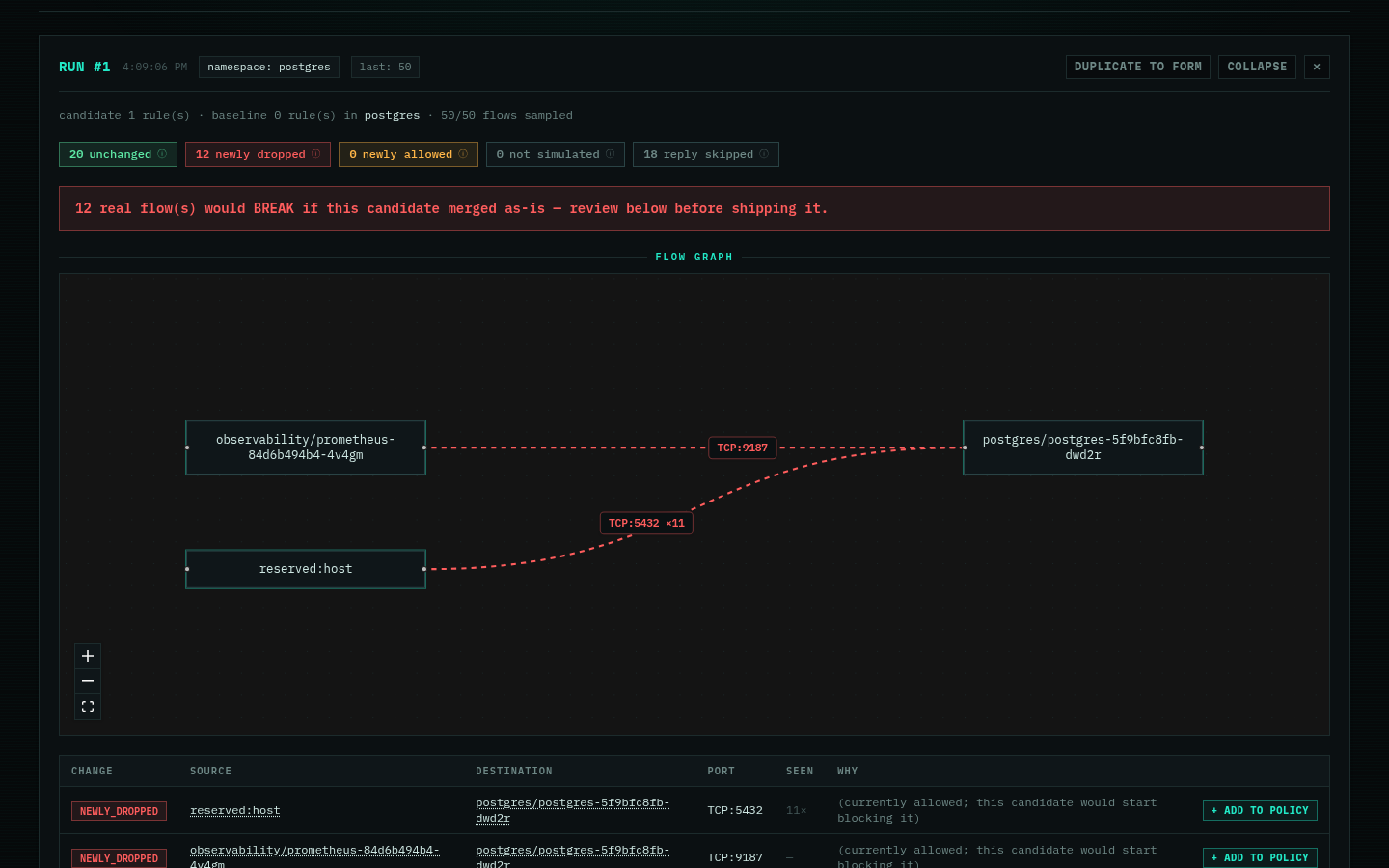
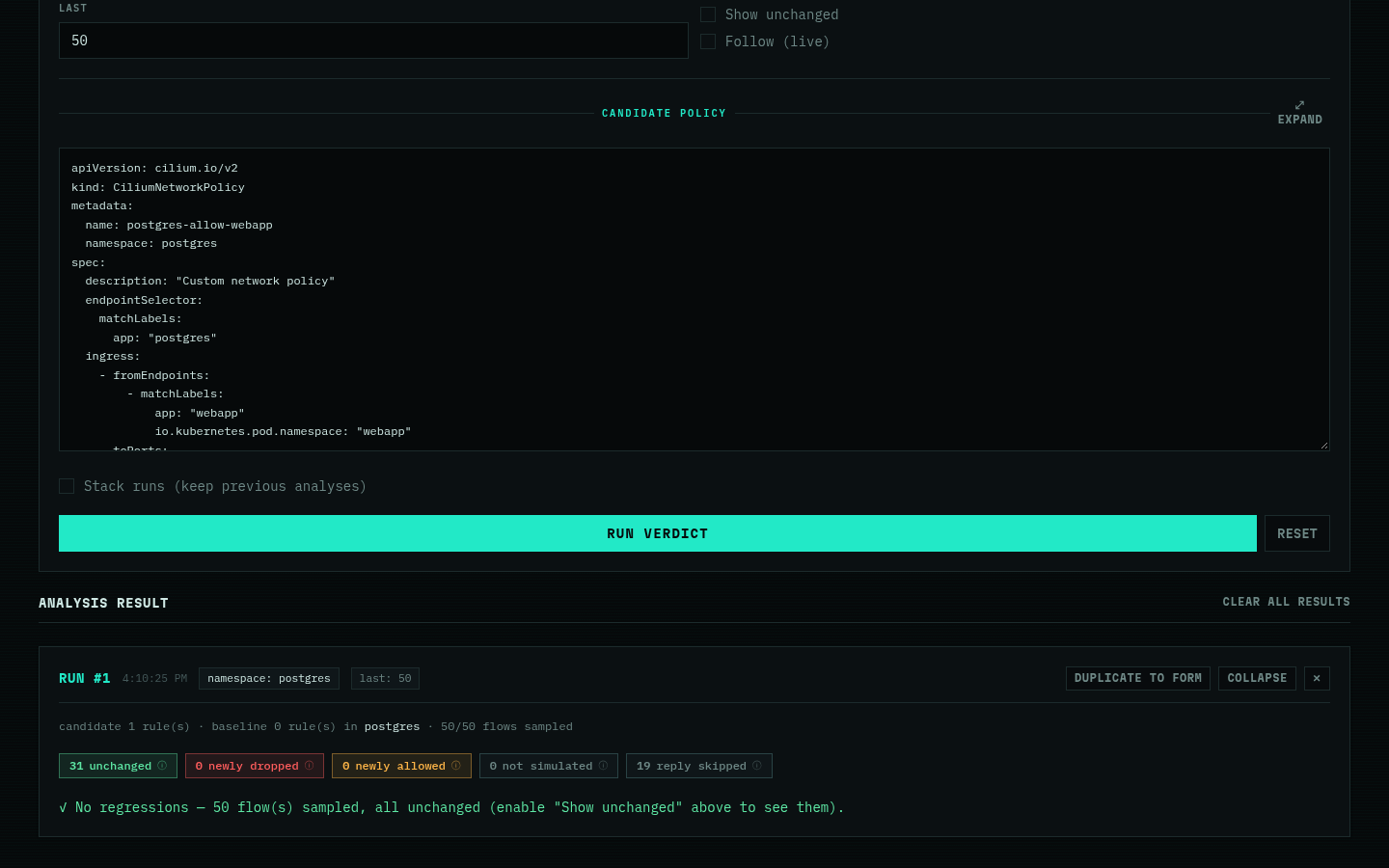
Left: looks correct, isn’t. Right: same candidate, fixed — every real flow unchanged.
examples/postgres-wrong-port.yamlis a variation on the same mistake (a typo’d port instead of a forgotten peer), andexamples/postgres-deny-all.yamlis the maximal version (nothing allowed at all) — both runnable against the Lab the same way.
Cluster-wide lockdown
The same lesson, one level up: examples/ccnp-postgres-lockdown.yaml is
the CiliumClusterwideNetworkPolicy version of the same story —
guardbee verdict --all-namespaces --last 50 \
  examples/ccnp-postgres-lockdown.yaml
— needing --all-namespaces instead of -n postgres to simulate
correctly. A namespace filter pinned to one destination namespace can
miss a CCNP’s true blast radius, and you may not know it in advance
anyway.